

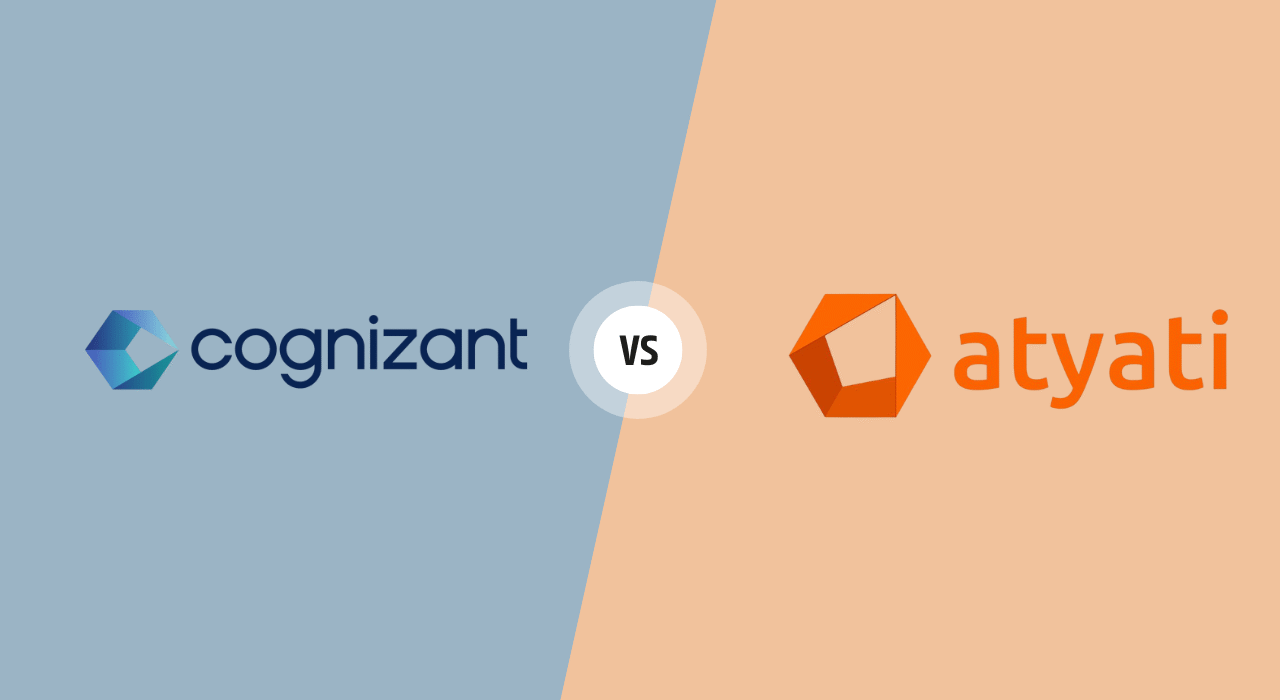
Cognizant vs Atyati logo case has become one of the most talked-about legal disputes in India’s IT industry. September 2025, Mumbai — The Bombay High Court’s decision to prohibit the multinational IT services behemoth Cognizant Technology Solutions from using its new logo in India has caused a stir in the Indian legal and technological community. Cognizant and Bengaluru-based Atyati Technologies are involved in a trademark dispute that is rapidly growing in importance in the nation.
In addition to being a legal battle over design rights, the case emphasizes how crucial intellectual property (IP) protection is becoming in India’s booming tech industry, where even large firms are coming under intense court scrutiny.
The Core of the Dispute
Cognizant introduced a new worldwide corporate concept in 2022. Its new logo was meant to represent agility, digital innovation, and contemporary enterprise solutions. It was a simple, geometric design with blue hexagonal motifs.
However, Atyati Technologies, a domestic provider of financial inclusion solutions and IT services, voiced concerns shortly after the branding. Cognizant’s logo, according to Atyati, was remarkably similar to its own registered mark, an orange hexagonal honeycomb device that was first used in 2019 and is formally trademarked across a number of service categories.
Atyati asserted that the two logos’ similarity was not only accidental but rather substantial enough to lead to misunderstanding in the marketplace. Customers, partners, or potential clients may mistakenly believe that Atyati and Cognizant are related, weakening Atyati’s unique brand identity.

The Legal Journey So Far
Atyati’s request for an injunction brought the case before the court for the first time in early 2024.
- March 2024: To prevent Cognizant from using the mark in India, the Bombay High Court first issued an ex parte temporary injunction.
- A one-judge panel temporarily changed the order in June 2024, permitting Cognizant to keep using the logo until additional proceedings.
- In September 2025, a division bench made up of Justice Sandeep V. Marne and Chief Justice Alok Aradhe reversed the previous relief and restored the injunction. Until the matter is resolved, Cognizant is not permitted to use the contested mark in India.
The judges observed that Atyati had proven a prima facie case of trademark infringement and that, until a full trial was held, it was more convenient to preserve the intellectual property rights of the smaller domestic company.
Cognizant’s Response
Cognizant promptly complied with the most recent directive from the High Court. The business took down its logo from all Indian internet platforms, including X (previously Twitter), Facebook, YouTube, LinkedIn, and its official website.
The action was a sign of damage control as well as legal conformity. Insiders indicate that Cognizant is considering its options, despite the company’s failure to publicly release a comprehensive comment on the conflict:
- Appeal to the Indian Supreme Court, asking for the injunction to be lifted.
- Rebranding its activities in India using a new or altered logo.
- In order to prevent protracted litigation, an out-of-court settlement with Atyati is being considered.
Being compelled to function without its standard logo in one of its main markets is no small setback for a multinational corporation the size of Cognizant.
Why the Logos Matter
Logos are more than just components of design. In the eyes of their clients, they stand for recognition, trust, and reputation. Branding is crucial for IT companies to stand out in a competitive market because differentiation is subtle and mostly focused on intangible services.
Even though Atyati is far smaller than Cognizant, it has spent years developing its corporate identity around its symbol, which is shaped like a honeycomb. It contends that permitting Cognizant to employ a comparable design would obscure its uniqueness and unjustly favor the bigger company.
The ruling by the Bombay High Court demonstrates the judiciary’s dedication to shielding smaller domestic firms from potentially dominating multinational enterprises.
Implications for Cognizant
The order has significant ramifications for Cognizant’s activities in India:
- The disruption of brand visibility
In the absence of its logo, Cognizant’s online presence in India appears lacking and at odds with its worldwide brand. Clients and possible recruits may become confused as a result. - Costs of Rebranding
The expenses could reach crores of rupees if Cognizant decides to revamp their logo specifically for India. In addition to designing logos, this also entails changing documents, websites, ads, workplace signage, staff gear, and more. - Reputation for IP Compliance
The case serves as a warning: even multinational behemoths need to carefully check their trademarks and emblems before entering or doing business in India. - Reputation for IP Compliance
The case serves as a warning: even multinational behemoths need to carefully check their trademarks and emblems before entering or doing business in India.
Wider Industry Impact
The Cognizant vs Atyati logo case controversy has wider implications for India’s tech and startup scene than just two businesses:
- Increased IP Awareness: The decision is probably going to motivate new businesses and small businesses to proactively register and safeguard their brand identities, trademarks, and logos.
- Global Players on Notice: When rebranding, multinational corporations will exercise greater caution and make sure that local trademarks are checked before releasing designs.
- Judicial precedent: The case gives smaller domestic businesses more confidence by enhancing India’s standing as a nation with vigorously enforced intellectual property laws.
In many respects, this case resembles a David vs. Goliath scenario, in which a modest Indian business defended itself against a major international IT player and was granted legal protection.
Expert Views
Divergent viewpoints have been expressed by legal experts:
- Support for Atyati: A lot of intellectual property attorneys contend that the court was right to give the first registrant’s rights, regardless of size, priority. Trademark law is straightforward: rights are established by registration and prior usage.
- Concern for Multinationals: According to some business analysts, these decisions can make multinational corporations hesitant since they might view India as a challenging environment for maintaining a consistent global brand.
However, the majority concur that the case emphasizes how crucial it is to exercise due care and observe regional intellectual property laws.
Conclusion
An important turning point for India’s legal and technological industries is the Cognizant vs Atyati logo case controversy. It demonstrates that intellectual property is just as important as invention itself in the cutthroat world of today.
The decision is a significant victory for Atyati, validating years of brand development. It serves as both a setback and a reminder to Cognizant that even the most influential multinational corporations have to follow local regulations.
Businesses in India and elsewhere will be keenly monitoring the case as it progresses, taking away important lessons about the value of trademarks, the dangers of oversight, and the growing significance of brand identification in the digital age.